We have chosen for you. It’s not the right location? You can change it anytime.



How is inflation calculated?
We know the kind of impact that inflation can have on our purchasing power. But how do they go about measuring it?
April 20th, 2026
The inflation rate is one of the most important indicators for economists… and for the general public. For example, if you hear that last year’s inflation rate was 3%, you’ll probably assume that your household expenses increased by that much.
In fact, the reality is more complicated.
Inflation in a nutshell
To begin with, inflation, as you know, is the increase in the price of goods and services over time. This kind of growth is a natural economic phenomenon caused by a variety of factors, including the law of supply and demand and rising production costs.
Inflation is measured using the “consumer price index,” or CPI. The CPI establishes the price that Canadian households would pay for a basket of goods and services representative of their spending habits. The greater the increase in the CPI basket price, the higher the inflation rate. For instance, if the basket went from $100 to $105 in a given year, the annual inflation rate would be 5%. Conversely, if the price of the basket remains quite stable, the inflation rate will be low. To put things in perspective, over a very long period, i.e., from 1915 to 2026, the average annual inflation rate in Canada was 3.13%.
An index based on consumer spending patterns
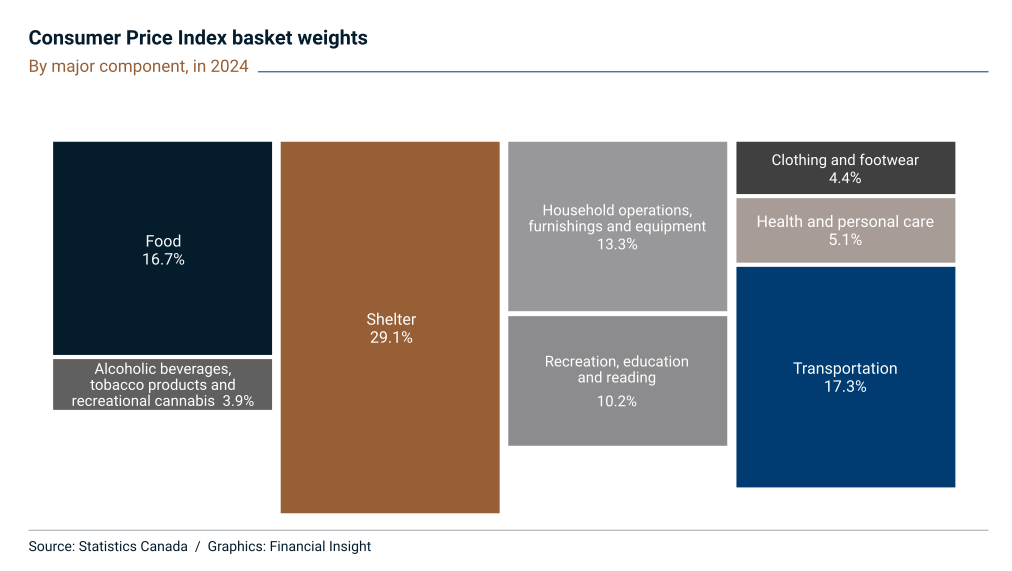
Developed by Statistics Canada, the CPI takes into account the relative importance of different expense items in a household budget. Thus, food and shelter are weighted more heavily than clothing and health care, because they account for a much higher proportion of a household’s spending. This weighting allows the measurement of inflation to be aligned as closely as possible with what households are actually experiencing.
To each their own… inflation rate
Nonetheless, there are some significant distinctions. The inflation rate is an estimated average based on data collected by Statistics Canada. Depending on your specific situation and your consumption profile, this rate might not accurately reflect your own experience.
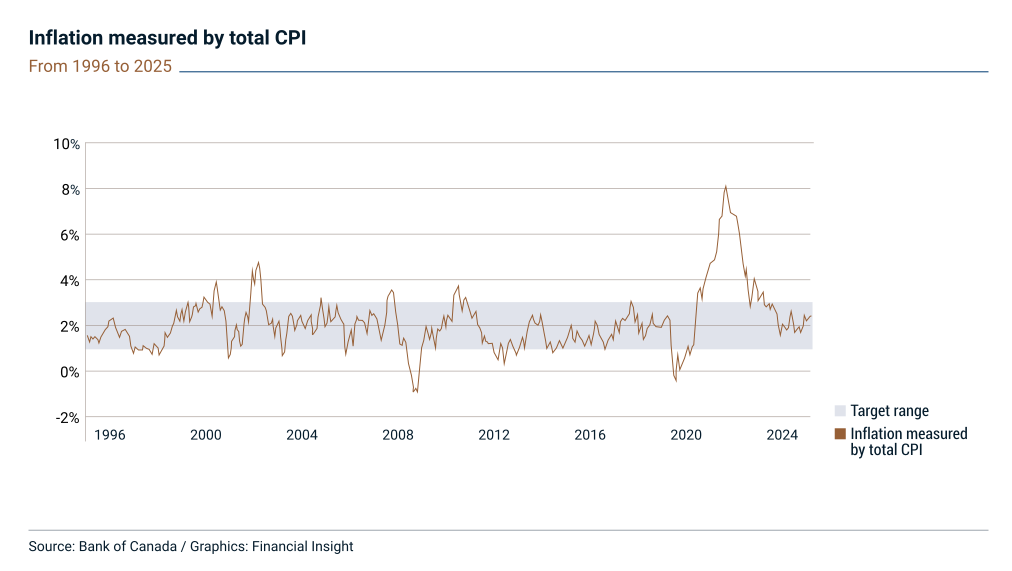
For example, as shown in the following graph, the inflation rate increased sharply in 2022, notably due to the war in Ukraine and disruptions in the energy markets. During this period, car drivers likely saw their costs increase more than public-transit users.
If you would like to have a more accurate idea of your own inflation rate, Statistics Canada has a specially designed Personal Inflation Calculator.
Why it matters
The measurement of inflation is important in a number of regards.
First of all, many government benefit programs, pension plans, collective agreements and commercial leases are indexed to inflation.
As well, as an investor, you can refer to it, along with your advisor, to help fine-tune your investment strategy. Let’s say you have been a disciplined investor for 25 years and your annual return is 4%, but inflation is 5%: in reality, you’re getting poorer. So it could be important to aim for returns that will take inflation into account – without resulting in an inappropriate level of risk, of course.
Finally, inflation has an impact on the cost of loans. The Bank of Canada uses its key policy rate to boost or restrain consumption in order to keep inflation within a range centred on 2% per year, a level considered optimal for the health of the economy. So, through this monetary policy, inflation is also reflected in your borrowing.
Points of interest
The measurement of inflation has some interesting features.
For one thing, contrary to what might be expected, real estate prices are not included. This is because Statistics Canada considers real estate to be an investment. Instead, the “Shelter” category includes the cost of rent, mortgage interest, municipal taxes, maintenance and repairs.
For another, the composition of the CPI basket is constantly evolving. For example, some products that didn’t exist 25 years ago are now included: think of smartphones or digital subscriptions.
The CPI also has a qualitative component. Take the case of a computer that costs more, but mainly due to improved performance (memory, storage, microprocessor, etc.). Statistics Canada will attribute part of the higher cost to upgrading rather than inflation.
Finally, it’s important to note that when the Bank of Canada talks about inflation, it is often referring to the “underlying” or “core” inflation, a measurement that excludes certain volatile components, such as food and energy, in order to get a better sense of the fundamental trend.
Not to be disregarded
As we can see, understanding inflation means gaining a better appreciation of the real change in your purchasing power — and the financial decisions associated with that. To gain more clarity about this topic, talk to your advisor.
The following sources were used to prepare this article:
Autorité des marchés financiers, “Inflation and its impacts on your finances.”
Bank of Canada, “Price check: Inflation in Canada”; “Underlying inflation: Separating the signal from the noise.”
BDC, “Inflation.”
CBC, “Here's how inflation works and what can be done about rising prices.”
Desjardins, « Qu’est-ce que l’inflation? »
La Presse, “Calculer son taux d’inflation personnel.”
Radio-Canada, “Comment est calculée l’inflation?”
Statistics Canada, “Consumer Price Index: Frequently asked questions”; “Personal Inflation Calculator”; “An Analysis of the 2025 Consumer Price Index Basket Update, Based on 2024 Expenditures”; “Shelter in the Canadian CPI: An overview, 2023 update”; “Consumer Price Index (CPI)”; “Chapter 7 – Quality Change and Adjustment.”
Trading Economics, “Canada Inflation Rate.”

