We have chosen for you. It’s not the right location? You can change it anytime.



How your investments are taxed: something to keep in mind
Did you know that not all of your investment income is taxed in the same way?
January 21st, 2026
It may slip your mind when investing in an account like a registered retirement savings plan (RRSP), where the investment income is tax-sheltered as it accumulates over the years, but in fact the income generated by our investments almost always ends up being taxed.
Here’s an overview of taxation as it applies to investment income.
Two main categories
First, let’s clarify that there are two main account types that can hold the investments you make as an individual:
registered accounts; and
non-registered accounts.
The first category includes tax-deferred accounts such as the registered retirement savings plan (RRSP), the registered education savings plan (RESP) and the first home savings account (FHSA). In these accounts, all of the investment income you earn is tax-exempt until you withdraw it. At that time, it is taxed as ordinary income at the prevailing marginal rate (except in the case of an FHSA if the funds are used to buy a qualifying home). The tax-free savings account (TFSA) is also part of this group: in this case, the investment growth is tax sheltered and withdrawals are also tax exempt.
The second category includes all accounts where investment income is taxable when it is realized.
Three types of investment income
In a registered account, all investment income is treated in the same way, regardless of whether it comes from corporate equities or simple term deposits. It’s different for non-registered accounts, though, where investment income is divided into three main groups:
interest income
This is the income generated, for example, by your term deposits, guaranteed investment certificates (GICs) or certain mutual funds* that invest in debt securities.
dividends
Dividends are essentially a portion of earnings that corporations pay to their shareholders. (Dividends are referred to as “eligible” if they are paid by public companies taxed at the general corporate tax rate and “non-eligible” if they come from a private company taxed at the small business rate. Eligible dividends receive more advantageous tax treatment.)
capital gains
Lastly, capital gains represent the growth in value of the corporate shares you hold, either directly or through a mutual fund, and that you “realize” when these shares are sold.
How are they taxed?
As a general rule, the government tends to encourage risk-taking by investors, since this encourages economic growth. That’s why only half of a capital gain has to be included in taxable income, while interest income, associated with less risky investments, is fully taxable. The taxation of dividends is more technical: first they are “grossed up,” but are then eligible for a tax credit. In the end, they are usually taxed at a rate that is lower than interest income but higher than capital gains. (It’s important to note, however, that dividends generated by U.S. investments and held outside of certain registered retirement accounts, such as an RRSP, might also be subject to U.S. withholding tax and will not qualify for the dividend tax credit. Special rules may also apply to investments held in other countries, depending on the tax treaties in place between Canada and the country in question.)
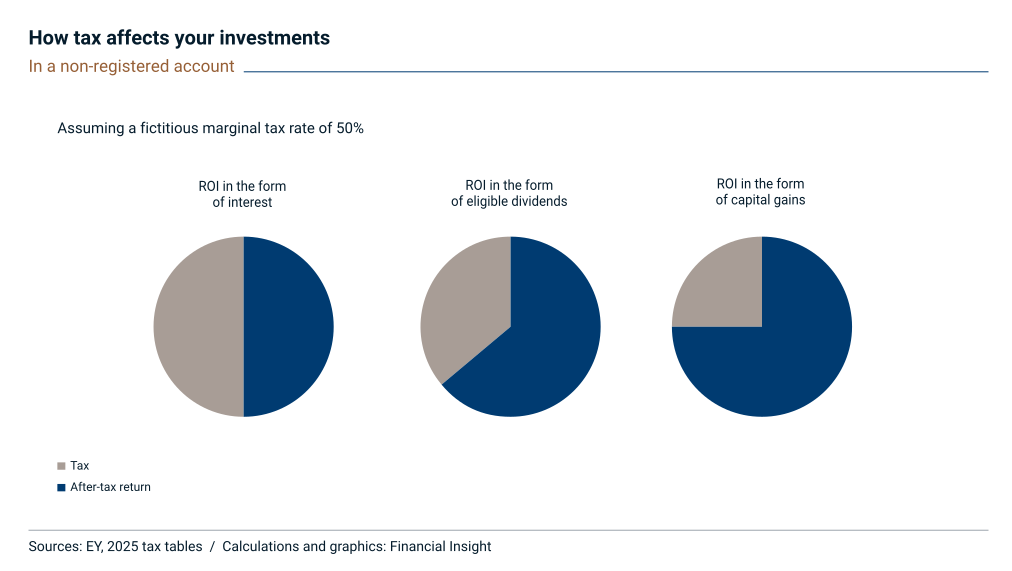
To illustrate, the following graph shows that if you lived in Quebec and your marginal tax rate was 50%, your taxes might eat up half of your interest income and a little over one-third (38%) of your income from eligible Canadian dividends, but just one-quarter of your capital gains. The actual figures would depend on your province of residence and your tax bracket.
A double whammy
So your net return after taxes could vary greatly depending on whether the income was in the form of interest, dividends or capital gains. Let’s say that your investments brought in $10,000 over the past year. Assuming a marginal tax rate of 50%, you would only have $5,000 of that left if it was interest, but $7,500 if it was a capital gain.
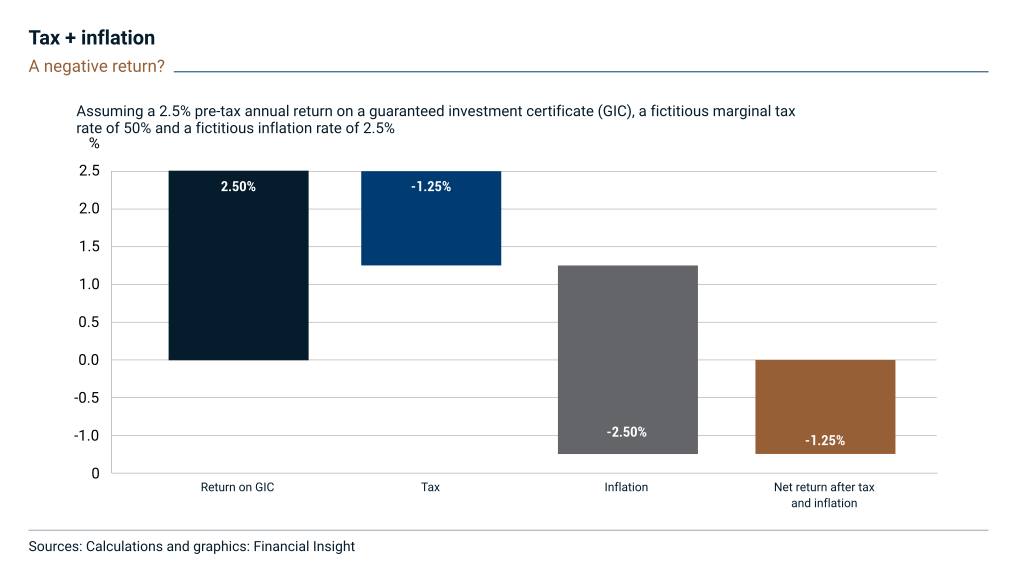
The numbers are even more telling when we take into account the double whammy of tax and inflation, since inflation also reduces the value of your assets by eroding your buying power every year. To use a simplified example, suppose that you invest in a GIC that pays 2.5% annually and the annual inflation rate is also 2.5%. As we can see here, not only does inflation negate your return but, once the tax has been deducted, you could find yourself with a negative net return: in real terms, you would be getting poorer.
Some elements of strategy
What lessons can be drawn from these observations? Your advisor is the person best qualified to provide advice tailored to your personal situation. Nonetheless, here are a few general principles, if your assets allow you to hold both registered and non-registered investments.
Tax is also a form of investment risk
When people think of investment risk, it’s most often about the possibility of investments losing value due to falling stock markets. But income tax can also take a bite out of your returns, which is why it might be a good idea to develop a tax optimization strategy.
Optimize your asset allocation from a tax perspective
For example, in a non-registered account your capital gains are taxed at a much lower level than other investment income. However, if you were to realize capital gains in a registered account, such as an RRSP, they would completely lose this advantage: when withdrawn, they would be taxed without discrimination, as if they were interest income. You might want to optimize your portfolio accordingly.
Think about tax-loss harvesting
Another example: in a non-registered account, although you have to pay tax on the capital gains you have realized, you can also deduct your capital losses. Your underperforming investments can become a tool for reducing your tax bill.
TFSA: the investor’s best friend
Finally, the importance of the tax-free savings account in an investment tax optimization strategy cannot be overstated, since any eligible Canadian investments you hold in it are exempt from all taxes for life.
These are just a few examples. If your situation calls for it, ask your advisor for more information about this topic!
* Mutual funds are offered by group savings representatives at SFL Investments, a financial services firm.
The following sources were used to prepare this article:
Autorité des marchés financiers, “Saving plans”; “TFSA – Tax-Free Savings Account.”
CFA Montréal, “The Impact of Inflation.”
Chaire en fiscalité et en finances publiques de l’Université de Sherbrooke, “Crédit d’impôt pour dividendes.”
Conseiller.ca, “Placements et inflation.”
Desjardins, “Foreign Investments in an RRSP or TFSA”; “How tax affects your investment income”; “Comptes non enregistrés : réduire ou reporter votre impôt.”
Finance et investissement, “Quels placements dans quels comptes enregistrés?.”
Get Smarter About Money, “How are your investments taxed?”; “How inflation affects your investments.”
Government of Canada, “Capital losses.”
La Presse, “La différence entre un placement enregistré et un placement non enregistré.”
CIRO, “Invest smart: Taxes and Investing.”
TurboTax, “How Are Dividends Taxed in Canada?”; “What's Tax Loss Harvesting?.”

