We have chosen for you. It’s not the right location? You can change it anytime.



Investing when the market is at an all-time high: something to avoid?
When it comes to investing, the old saying tells us to buy when the markets are low and sell when they’re high. But what if that weren’t entirely true?
January 21st, 2026
With positive returns coming in quick succession these past few years, the major indexes have repeatedly hit new highs. This situation makes some investors nervous. Knowing that steep declines are also part of the normal market dynamic, might it be a good idea to stop putting money in, and even to sell off investments while there’s still time – i.e., before the start of the next bear market?
Some historical data can help provide a balanced answer to this question.
What usually follows a stock market peak?
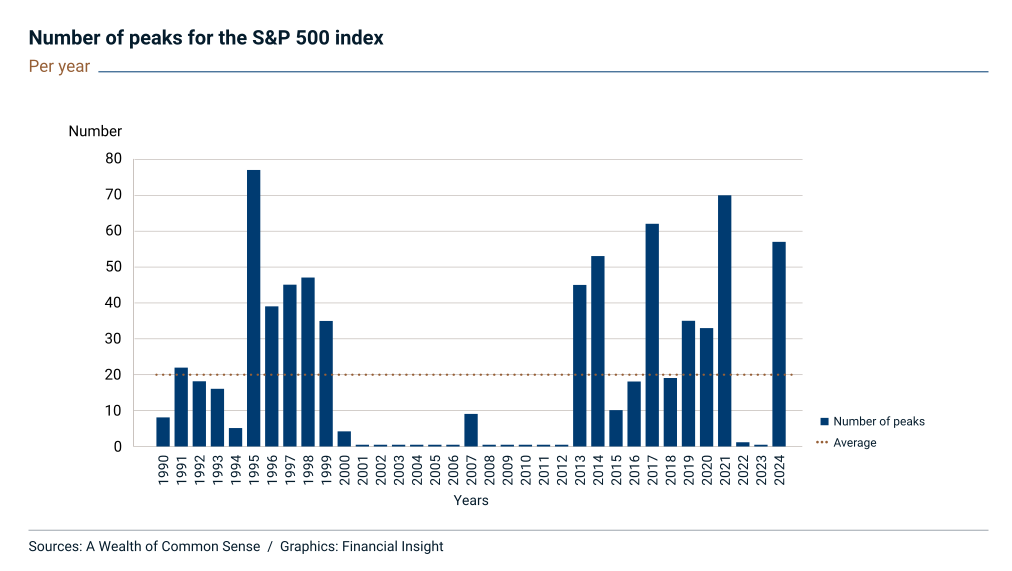
Contrary to what may seem intuitive, stock market peaks are often part of a phase where the markets continue to rise and are not usually followed by declining prices. There’s a reason for this: a bull market is generally driven by investor optimism about the economy and the outlook for listed companies. So the markets go from peak to peak over a stretch of months, or even several years.
In fact, as shown in the graph below, an index such as the S&P 500, considered to be representative of the U.S. stock market, can reach new all-time highs many times a year. To decide when the time is right to “sell high,” you would have to be able to tell which peak is the one before a significant decline, which is almost impossible. Otherwise, you might lose out on some potentially worthwhile investment growth.
But would it still be good to proceed with caution?
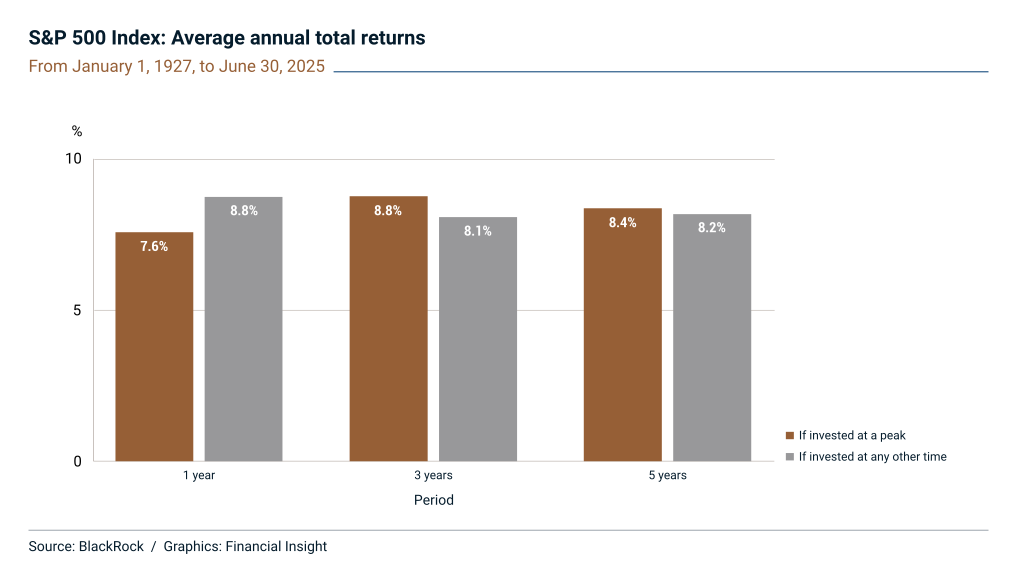
That said, after many years of stock market peaks, would it be such a bad strategy to keep your money on the sidelines, ready to invest when the prices inevitably decline? The next graph, based on the behaviour of the S&P 500 index during the past century, casts some interesting light on this question. As we can see, investments made only at a market peak, i.e., at the “wrong” time, would have had medium-term returns similar to – or even slightly better than – investments made at any other time in the market cycle.
Five strategies, five results
Along the same lines, a recent study compared the returns obtained by five investors, each with $2,000 to invest in the U.S. stock market on January 1 of each year. The first waited and had the improbable luck of investing when the market was at its lowest point for each year. The second also waited, but had the (also improbable) bad luck of investing when the market was at its peak for each year. The third invested everything at the beginning of the year. The fourth invested equal amounts in each month throughout the year; and the fifth waited for “the right time” all year… without ever investing. Unsurprisingly, after 20 years, investor number one came out the winner with assets worth more than $186,000, while number five ended up with just $47,000. However, investor number two, who always bought at the wrong time, had about $151,000, while investors three and four ended up with about $170,000 and $166,000 respectively.
Given that it’s impossible both to guess when the market has bottomed out in each year and to be unlucky enough to systematically invest at the market peak, these “happy medium” investors would seem to have made the best decision.
The cost of not being in the market
Indeed, many studies have shown that trying to synchronize your investments with the markets by getting in and out at the optimal time actually presents a significant investment risk. For example, taking the S&P/TSX Total Return index as a benchmark, if you had put $10,000 into the Canadian stock market on January 1, 1986, and stayed invested the whole time, your investment would have been worth over $241,000 by the end of 2024. But if you were trying to time the highs and lows and were out of the market only on the ten best days during this period of almost 40 years, your assets would amount to barely $113,000. And if you had missed the best 40 days – about one day per year, on average – your nest egg would only be $34,000. So, in all likelihood, trying to time the market could be a risky strategy.
A middle way
Not to be ignored, however, are the comments of the many analysts who point out that the positive stock market returns in recent years disproportionately stem from a small number of companies operating primarily in technology and artificial intelligence. The word “bubble” has been tossed around, which brings back painful memories for investors who were there 25 years ago when the tech bubble burst.
Under the circumstances, knowing that trying to time the market can be riskier than staying invested regardless of what happens, one approach to discuss with your advisor might be periodic investment. This consists of investing an equal amount every month, no matter what. With this approach, when the markets fall you get a good deal since you’re buying at lower prices. And when the markets are on an upswing, although you pay more for your securities, you then get to watch them gain in value from month to month. In a way, you are averaging out your cost over time, which is why this approach is known as “dollar-cost averaging.” As shown above, this approach could turn out to be less profitable than investing every possible dollar as soon as you have it, but it’s a middle way that could help you sail through the ups and downs of the market with more peace of mind.
Regardless of your current approach, the start of a new year is a good time to talk things over with your advisor, keeping in mind that it’s normal for the markets to reach ever-higher peaks, but just as normal for a more-or-less drastic correction to occur one of these days.
The following sources were used to prepare this article:
AdvisorAnalyst, “Fear, greed and the myth of stock market highs.”
A wealth of common sense, “Investing a Lump Sum at All-Time Highs.”
BlackRock, “Fear, greed and the myth of stock market highs.”
BNY, “Should You Invest at Market highs?.”
Fidelity, “Can you time the stock market?.”
Investopedia, “Dollar-Cost Averaging (DCA): What It Is, How It Works, and Example.”
Les affaires, “Bourse: le phénomène du retour à la moyenne.”
Schwab Center for Financial Research, “Does Market Timing Work?.”
Schroders, “Scared of investing when the stock market is at an all-time high? You shouldn’t be.”

