We have chosen for you. It’s not the right location? You can change it anytime.



Understanding stock market indices
In five questions – and answers.
April 20th, 2026
Rising or falling, stock market indices set the tone for day-to-day financial activity. Here are five key concepts for making sense of them.
What is a stock market index?
A stock market index is a selection of stocks intended to represent a market or a market segment. Its value is measured in points and undergoes constant recalculation whenever the markets are open, based on changes in the prices of the included stocks.
The purpose of an index is to provide a benchmark for measuring the overall performance of a specific market, such as the Canadian stock market, and comparing it with the performance of a given investment portfolio. If your portfolio is fully aligned with an index, its performance should generally approximate that of the index. On the other hand, if it has a different asset mix, your returns could also differ – either positively or negatively.
Note that you cannot invest directly in a stock market index, but there are investment vehicles, such as index funds, that replicate the composition of a given index.What do “points” mean in an index?
When you hear that an index is at 5,000 points or 50,000 points, this number has no absolute meaning. It is a mathematical value calculated from a starting point. For example, when the S&P 500 was created back in 1957, it was valued at 10 points. At the time of this writing, it is valued at about 6,300 points. The important part is converting these points into percentages. So if the Canadian S&P/TSX index were to gain 300 points in the 1980s, when it was valued at 3,000 points, this would represent a 10% return on investment. Now that the S&P/TSX is over 30,000 points, the same 300-point gain would only equal 1%.How is an index created?
Two main criteria come into play when creating an index:Stock picking
Not every listed company is included in its corresponding index. The ones that qualify must meet specific selection criteria: market capitalization, share liquidity (i.e., the shares are easy to buy or sell), industry sector, minimum profitability, etc. For example, several thousand securities are listed on Canadian stock markets, but fewer than 250 have been selected for inclusion in the S&P/TSX Composite index.
Weighting
As we will see later, it is essential to know how much of an index’s value is constituted by a given company (known as its weighting) in order to read the index correctly. Most of the major indices are capitalization-weighted: the higher a company’s market capitalization, the greater its weighting within the index.
How many stock indices are there?
There are thousands of stock indices all over the world, calculated by specialized firms such as S&P Dow Jones, MSCI or FTSE Russell. Each developed country has its own national indices: in Canada, the most familiar is the S&P/TSX Composite index; in the U.S., the major indices are the S&P 500, the Dow Jones Industrial Average and the Nasdaq Composite index; in France, it’s the CAC 40; in Japan, the Nikkei 225.
In addition to these large national indices there are sector indices (technology, energy, etc.), regional indices (Europe, Asia-Pacific, etc.), factor indices (low volatility, high dividend, growth, value, etc.), and thematic indices (artificial intelligence, energy transition, etc.). The bond market also has its own benchmark indices, although these are not, strictly speaking, stock market indices.Do the indices give an accurate picture of the financial situation?
Yes and no. While stock market indices allow you to evaluate your own portfolio against a benchmark, sometimes a closer look is in order. This has been the case for the past few years: the market value of a small number of technology and artificial intelligence companies has increased so massively that their index weighting has become disproportionate. In fact, at the time of this writing, Alphabet (Google), Amazon, Apple, Meta (Facebook), Microsoft, Nvidia and Tesla alone comprise about one-third of the S&P 500. The rest is spread across the index’s other 493 companies.
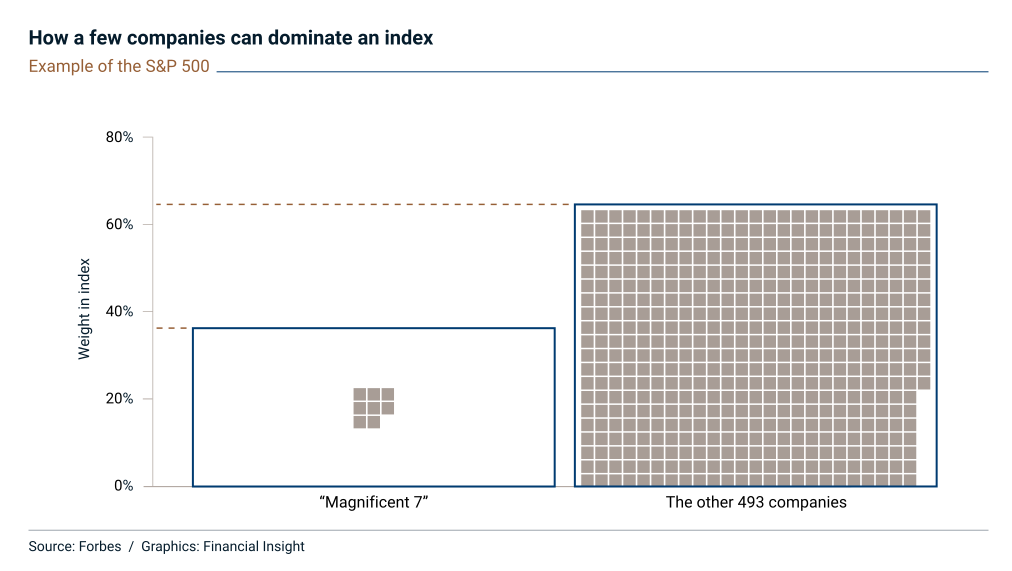
Thus, care should be taken when reading an index, since it can be moved up or down without necessarily reflecting the performance of the wider range of its constituent stocks. For example, if your portfolio is designed to protect you against an eventual correction in the tech sector, its performance is unlikely to mirror that of an index dominated by technology firms: this divergence would simply be the result of a more defensive strategy.
Stock market indices are a plentiful source of other useful information, as well. To learn more about them, talk to your advisor.
The following sources were used to prepare this article:
Bloomberg, “Bloomberg Equity Indices.”
Forbes, “S&P 500's Weight In Mag 7 Stocks Passes 30%. Is This A Diversification Risk?”
Investopedia, “Understanding Stock Market Points: What They Mean for Investors”; “Understanding the S&P/TSX Composite Index: Definition and Investment Guide”; “Magnificent 7 Stocks.”
S&P Global, “Data & Index Licensing”; “What is an Index?”

