We have chosen for you. It’s not the right location? You can change it anytime.



What return should you aim for in retirement?
Or how to balance wealth preservation and long-term needs.
May 28th, 2026
When it comes to savings and investments, retirement often signals a transition from the “accumulation” phase to the “distribution” phase. Indeed, most people stop contributing to their retirement savings once their working life is over, and start using this money to provide an income.
At that point, it would seem logical to minimize portfolio risk to protect the precious accumulated wealth, even if it means settling for lower returns. But is that really the only option? Here are a few discussion points to help you make up your own mind.
Factor 1: The future lasts a long time
The first point to consider is the fact that in the past century, life expectancy has soared. These days, it’s not unusual for retirement to last 25 or 30 years, or more. So a person’s accumulated savings have to provide an income for all that time.
What does that mean in practical terms? Imagine a 65-year-old who has saved a million dollars in retirement capital and would like to withdraw an annual income of $50,000, indexed at 2% per year. Based on these simplified assumptions, an average annual return of about 5.5% would be required for the person’s savings to last until age 95 (note that for simplicity, taxes have not been factored into this equation, even though they could have a significant impact in a real-world situation).
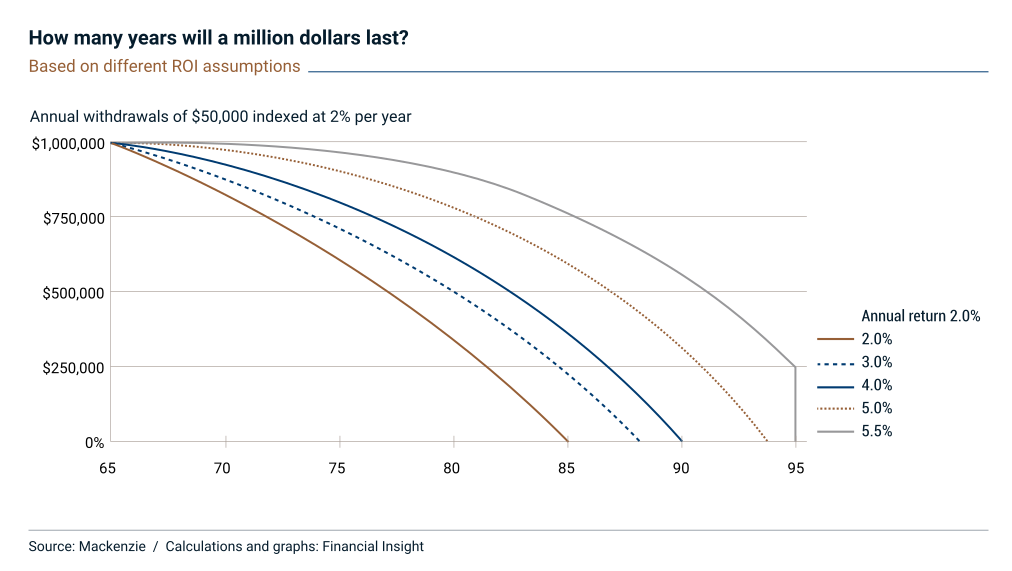
Do you think that would be easy to achieve? Keep reading.
Factor 2: Risk
The second point to think about is the type of portfolio needed to generate the required returns. Would it be a conservative portfolio or, conversely, one highly exposed to market volatility?
Based on the Institut de planification financière’s projection assumptions (which can change over time), it would be reasonable to expect an average annual return of 2.4% for short-term investments, 3.4% for fixed income securities (considered safe), and 6.6% for Canadian and U.S. equities (considered riskier). So, to achieve an average annual return of 5.5%, and assuming the portfolio keeps $50,000 in short-term investments, the person in our example would have to invest about 68% of his or her savings in the stock market. This largely equity-based portfolio would thus have a relatively high exposure to stock market swings.
Finding the sweet spot
This example gives a good picture of the dilemma faced by retirees: finding the right balance between the performance they need and the risk they can tolerate. A negative market performance – especially early in retirement when the distribution process is beginning – could play havoc with a portfolio too heavily weighted in equities. On the other hand, if the equity weight is too low, the portfolio might not achieve its performance targets and the capital could be depleted too soon.
So it’s important to evaluate your risk tolerance throughout your retirement. In this regard, an old rule of thumb states that the proportion of equities in your asset mix should equal “100 minus your age.” Thus, someone who is 65 years old should only have 35% of his or her portfolio in equities, and this weighting should gradually be reduced to further protect the capital as the investment horizon diminishes. This rule, now widely questioned, should be used with caution. In our example, the result of applying this “conservative” weighting could result in the capital being depleted shortly before the retiree reaches age 95.
Which brings us back to the question: what’s the appropriate return on investment to aim for in retirement?
Getting your risk profile right
Clearly, the answer depends on your income requirements and the amount of risk that your personal situation allows you to tolerate.
For example, if the retired person in our example only needed to withdraw $40,000 a year from savings instead of $50,000, a lower return – and thus a lower-risk portfolio – could be enough to provide income to age 95.
Similarly, if you can rely on benefits from a private or public pension plan, your personal savings will play a different role in your retirement income, and you might assess the risk-return profile of your assets in a different light.
The distribution plan
Distribution planning is an important – and complex -- operation. What are your needs and how will they change? What level of risk can you tolerate, and how will this tolerance change as you age? Are you planning to leave a legacy for your heirs? And so on.
So the answer to the question of what return you should aim for in retirement is a personal one. And a conversation with your advisor is a good place to start looking for yours.
Note
The projection assumptions cited here come from recognized authorities and are based on historical data. However, past performance does not guarantee future results and market investments carry inherent risk.
The following sources were used to prepare this article:
Canadian Money, “How Your Portflio Should (and Shouldn’t) Change With Age.”
Institut de planification financière, “Normes d’hypothèses de projection 2025.”
Mackenzie, “Investment withdrawal calculator.”
Perspective Monde, “Espérance de vie à la naissance.”
Statistics Canada, “Life expectancy at birth and at age 65”; “Life expectancy, 1920–1922 to 2009–2011 ».

