We have chosen for you. It’s not the right location? You can change it anytime.



What’s the point of life insurance for a business?
Does your business plan include a life insurance policy? Here are four reasons to consider it.
May 28th, 2026
Business owners are used to juggling all kinds of business risks: economic environment, labour shortage, supply chain, interest rates, regulatory framework… But one of the biggest risks is sometimes overlooked: the risk associated with the organization’s key personnel – starting with the owners themselves.
No one would ever wish this, of course, but the risk of something taking an owner or key employee out of the picture is very real. It can result in disrupted operations, put pressure on liquid assets, create uncertainty for business partners and creditors, and even threaten the company’s continuity.
And that’s where life insurance might make sense.
Four essential roles
When properly integrated with business planning, life insurance can meet a variety of strategic needs.
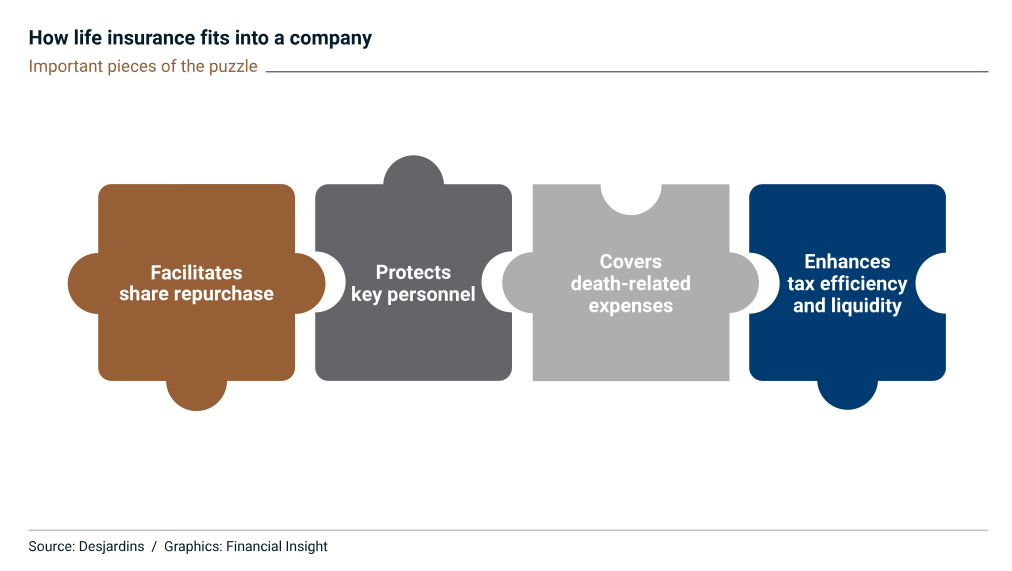
Let’s look at these components in detail.
1. Facilitates share repurchase
For a company owned by several shareholders, the death of one can create a sensitive situation. The surviving partners would usually want to retain control of the company, while the heirs would seek to obtain fair value for the deceased person’s interest. Without a mechanism for dealing with this issue, the situation could create tension, or even force the sale of the company.
A shareholder agreement funded by a life insurance policy can help manage this risk. The death benefit could be used to buy back the deceased’s shares, thus ensuring an orderly transition. The heirs receive financial compensation, while the partners retain control and business continuity is preserved.
2. Protects key personnel
Certain people play a central role in a company’s success: executive officer, founder, technical expert or business development manager, and so on. Their sudden absence can lead to lost revenue, disruption or a reconsideration of some business relationships.
A life insurance policy for a “key person” can provide the company with capital in the event of that person’s death. This cash can be used to buffer the short-term financial impact, finance the recruitment or training of a replacement, or reassure creditors and partners. This can help to stabilize the business during a difficult time.
3. Covers death-related expenses
The death of a business owner can also involve heavy financial obligations. These costs must often be paid on short notice, which can put pressure on the financial resources of the business or the estate.
Life insurance is a way of quickly freeing up the funds required to cover these expenses, be they taxes, legal fees or other costs associated with settling the estate. This helps to avoid the hasty sale of assets and preserve the estate’s value.
4. Enhances tax efficiency and liquidity
When life insurance is owned by a business, it can provide tax benefits at the time of the death. In general, the insurance payout is not taxable and can, under certain circumstances, be added to the capital dividend account (CDA). This could potentially allow for the payment of non-taxable dividends to the shareholders.
As well, in some circumstances, permanent life insurance can provide tax-sheltered capital growth within the policy, without generating taxable investment income. This can help reduce the impact of the “passive income” rules, which can increase the tax burden when investment income exceeds certain thresholds.
Beyond these considerations, life insurance offers a predictable source of cash, available when it is needed most.
An essential component of sound management
Clearly, then, life insurance can form part of an overall strategy, complementing other tools designed to provide for the company’s longevity or succession. Whether to ensure business continuity, protect the partners or cover specific financial obligations, it can transform a distressing event into an organized transition.
That said, many factors must be taken into account when implementing this tool: business structure, shareholder agreement, long-term objectives, tax considerations, etc. The advisor plays a central role. He or she can help to identify needs, structure a tailored solution and ensure that it remains appropriate over time, as the business grows in value.
In short, this is a forward-looking step that aligns with a sustainable vision for the company and its asset base.
The following sources were used to prepare this article:
BDO, “How corporate-owned life insurance can boost your liquidity”; “Tax Q&A”; “Estate planning strategies for owner-managers.”
Desjardins, “Business-owned life insurance”; “Business Insurability Coverage.”
Finance et investissement, “Bien assurer les propriétaires d’entreprise.”

