We have chosen for you. It’s not the right location? You can change it anytime.



Before the calendar decides for you
Some financial decisions to consider before the end of 2026.
November 20th, 2026
When we come to the end of the year with all its hustle and bustle, it’s tempting to put off making important financial decisions… until next year. But while it’s true that some decisions can wait, it might be better to deal with others before December 31, especially given that they could affect your next income tax return.
Here are a few points of reference to guide your deliberations and help prepare for the conversation you might like to have with your advisor.
The key factor: your taxable income
The main purpose of year-end planning is to make decisions that will put you in the best possible financial position in the future, in particular by reducing your tax bill or spreading it over time. One good place to start is to estimate your taxable income for 2026 and what you expect to earn in 2027. Did you get an annual bonus at work? Realize a substantial capital gain? Withdraw funds from a registered account? Receive dividends from your company? Redeem the cash value of a life insurance policy? Any one of these could increase your taxable income, and perhaps even put you in a higher tax bracket. By contrast, if you recently retired, took an unpaid leave of absence or cut back on your professional activities, the effect could be the opposite.
This type of calculation could help you decide if it would be more beneficial to claim or defer a deduction for registered retirement savings plan (RRSP) or first home savings account (FHSA) contributions, bring forward or hold off on a taxable withdrawal or deductible expense, or spread certain transactions over two years.
A few key deadlines
In this respect, it’s important to keep in mind that some of these decisions come with a “best before” date. As shown in the following table, this is the case for the major government tax programs: registered retirement savings plan (RRSP), registered retirement income fund (RRIF), tax free savings account (TFSA), first home savings account (FHSA), registered education savings plan (RESP), registered disability savings plan (RDSP). It’s also the case for other financial transactions that must be completed before year-end in order to apply to the 2026 tax year.
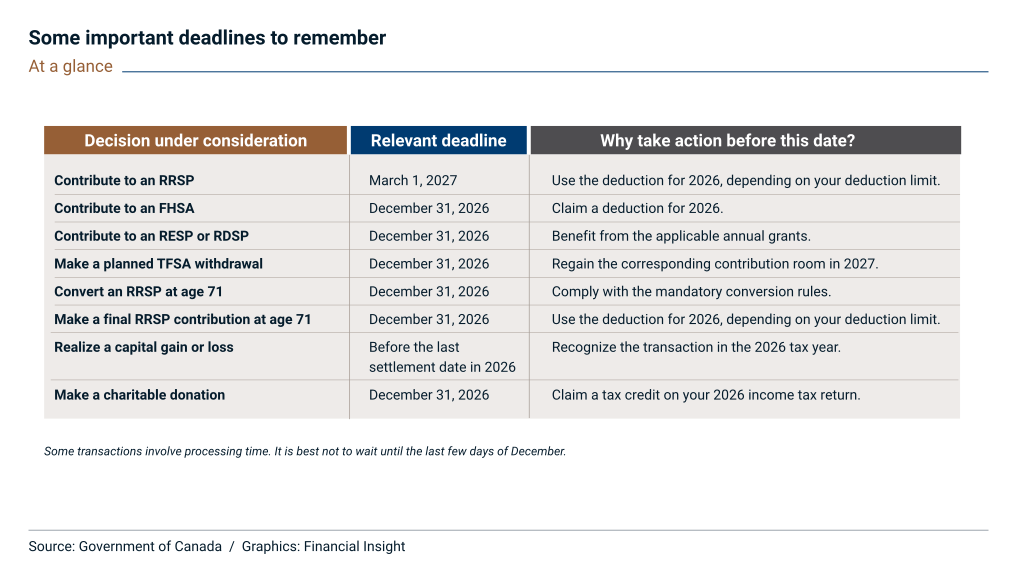
Let’s look at these items in detail.
RRSP: there’s no rush, but…
Making an RRSP contribution is one of the few decisions that you can put off, since you have the first 60 days of 2027 to complete your contributions for 2026. Your contribution limit equals 18% of your earned income for 2025 to a maximum of $33,810, plus your unused contribution room from previous years. (If you benefit from an employer-sponsored pension plan, your contribution room is also affected by the associated pension adjustment). However, did you know that you don’t have to deduct your contribution in the year you make it? You can defer it to a future year if you think that your income is likely to be substantially higher, which could maximize the impact. It’s better to think about this type of strategy with a cool head, and not put it off until all the hubbub of “RRSP season.”
By the way, a useful tip if you’re planning to use your RRSP to participate in the home buyers’ plan (HBP): it might be better to wait until 2027. Once you’ve made a withdrawal under the HBP, you have until October 1 of the following year to complete your purchase or build your home. By withdrawing the funds in early 2027, you’ll have until October 1, 2028, to complete your project. You might end up being glad of the extra time.
FHSA: Warning – you can’t carry forward forever
The FHSA lets you build tax-sheltered savings for the purpose of buying a qualifying first home. The participation room – which is tax deductible – is $8,000 per year, up to a lifetime total of $40,000. If you don’t use all of your participation room for a given year, you can carry it forward. Be aware, however, that the amount you can carry forward is capped at $8,000, equal to one year of participation room. Since any unused room in excess of this amount would be lost, it’s important to carefully manage each year’s contributions. [For more information about the FHSA, read this article.]
RESP and RDSP: get grants without waiting
The RESP and RDSP are also tax-advantaged plans, and they have a very attractive feature: they can provide eligibility for annual grants. These grants may be carried forward, subject to rules that vary depending on the plan, but one principle always applies: making a contribution before December 31 is the fastest way to receive the matching grants for the current year or unused entitlements, subject to the applicable rules and limits for each plan. One last important detail about the RDSP: in general, the matching grants and bonds are only paid up until the end of the year the beneficiary turns 49.
TFSA: sometimes it’s the withdrawals that need planning
The TFSA is another vehicle for building tax-sheltered savings. The dollar limit for contributions, set at $7,000 for 2026, can be deferred and will accumulate indefinitely. TFSA contributions are not tax deductible; withdrawals, on the other hand, are tax free. However, there is a significant time lag that should be kept in mind: any amount you withdraw is only added to your contribution room on January 1 of the following year. This means that a withdrawal made in December 2026 will create contribution room as of January 2027. But if the same withdrawal is made a few days later, in January, the associated contribution room will only become available in 2028. If you are planning to make a withdrawal and expect to have cash available to recontribute within the next year, withdrawing the funds before December 31 could give you more flexibility. [For more information about TFSA deposits and withdrawals, see this infographic.]
Turning 71: a pivotal year
If you turned 71 in 2026, be aware that you have to close your RRSP no later than December 31 by converting it to a registered retirement income fund (RRIF), purchasing an eligible annuity, or a combination of both. But if you still have contribution room, it’s not too late to make one last RRSP contribution – and deduct it from your income for 2026. Just be sure to do so before December 31 and, obviously, before closing your account. Even after closing your own RRSP, you can continue making contributions to your spouse’s RRSP if you still have contribution room and your spouse is under 71. Note, too, that as soon as your RRSP has been converted to an RRIF, you will have to start making yearly minimum withdrawals. However, when you set up the RRIF, you can ask that the minimum withdrawal calculations be based on your spouse’s age. This could result in lower taxable withdrawals if your spouse is younger than you are. Note that this decision is irrevocable.
Already retired? Keep an eye on your taxable income.
Some government programs, such as Old Age Security benefits and the Canadian Dental Care Plan, are income-based, with eligibility criteria specific to each program. If you would like to withdraw additional funds in a given year, it might be a good idea to draw on non-taxable sources, such as a TFSA, or use non-registered investments that would result in a capital gain upon disposal, since only a percentage of a capital gain would be added to taxable income. You could also mitigate the tax bite by spreading the withdrawal over two years, if possible. Ideally, this type of analysis should be part of an actual withdrawal strategy. Something to discuss with your advisor.
Taxable investments: put gains and losses together
If you have a taxable investment account and have realized a capital loss on some of your investments, you can generally apply this against taxable capital gains from the same year, thus reducing your tax bill. If you don’t use the whole amount, the remaining loss can be applied against capital gains from the previous three years or carried forward to a future year. This tax law provision opens the door to a common year-end strategy: tax-loss selling. Nonetheless, before selling an investment just to create a loss for tax purposes, it’s important to assess its quality and its role in your portfolio. In addition, if you – or an affiliated person – were to purchase the same investment within 30 days before or after the disposal, the sale could run afoul of tax rules regarding superficial losses, in which case the loss would generally be disallowed.
Charitable donations: when giving can be profitable
A donation to a qualified charitable organization made before December 31 can give rise to a tax credit for 2026. But did you know that you don’t have to make the donation in cash? You can also donate in the form of listed securities, which could offer the added advantage of eliminating the capital gains tax under certain conditions. Your donation could also be an in-force life insurance policy, which could provide other significant tax advantages, both for you and for the charitable organization [learn more in this infographic]. However, since organizations and financial institutions need time to process transfers of this kind, this is a strategy that needs to be put into play well before the last few days of December.
Year-end distributions: the income you weren’t expecting
Finally, if you hold mutual funds in a taxable account, you should be aware that such funds often distribute annual capital gains, dividends and interest income to their unitholders at the end of each year. In this case, early 2027 might bring you some tax slips showing taxable income for 2026, even if you haven’t received any money, because the distributions may have been automatically reinvested. So if you are planning to buy into a mutual fund in the next few days, you might want to ensure that the fund won’t suddenly pay out distributions that you would be taxed on next spring. On the other hand, if you already know that you will be receiving a substantial capital gain distribution from a fund, realizing capital losses on other investments might help to offset it, subject to the applicable rules.
Three points of interest for business owners
Take a fresh look at your compensation and expenditures
If you are a business owner, unlike most employees you can choose to declare your personal income as either salary or dividends. If dividends seem attractive, especially given the lack of payroll taxes and deductions, keep in mind that, unlike wages, dividends do not create RRSP contribution room, nor are they subject to Quebec Pension Plan (QPP) or Canada Pension Plan (CPP) contributions. Moreover, they do not affect the company’s operating expenses, and thus do nothing to help keep operating income below the eligibility threshold for the small business deduction (SBD), i.e., the lowest tax rate (see next point). So it could be important to weigh the pros and cons of each option, based on your specific situation.
Optimize the small business deduction
Revenue generated by an active business qualifies for the “small business deduction” (SBD), which is a reduced tax rate on the portion of your operating earnings under $500,000 (note that depending on the province, other conditions may apply, in particular the hours worked). When corporate earnings exceed the business limit, the SBD is not eliminated, but the excess income is usually taxed at the general corporate rate. Depending on the company’s situation, the timing of certain expenditures could have an impact on how taxable income is divided between two years and therefore on the portion of income that will benefit from the SBD. Be sure to get informed advice about setting your ideal balance point.
Be aware of passive income
The income that your business earns from investments qualifies as “passive income.” In contrast to operating income, passive income is taxed at the highest rate. But there’s more: passive income can affect your company’s eligibility for the small business deduction. When the adjusted aggregate investment income of a company and any associated companies exceeds $50,000, the SBD business limit begins to drop, and may be completely eliminated once passive income reaches $150,000. To limit your exposure to this provision, you might consider delaying the sale of certain investments that would produce capital gains, or putting a larger portion of your investments on a personal basis. Another way to deal with it, when justified by your situation and needs, would be to use solutions where growth is tax-deferred or tax-sheltered, notably certain permanent life insurance policies. However, this choice should be made as part of an overall strategy that you can develop with the help of your advisor.
Federal: the lowest income bracket is subject to less tax
Lastly, a quick note of interest to all individuals, remember that as of July 1, 2025, the federal tax rate on the lowest income bracket dropped from 15% to 14%. The 2026 tax year is thus the first time this reduction applies to your income for the whole year. The following chart provides an overview of the tax brackets in effect at the federal level. Different brackets and rates apply at the provincial level depending on your province of residence.
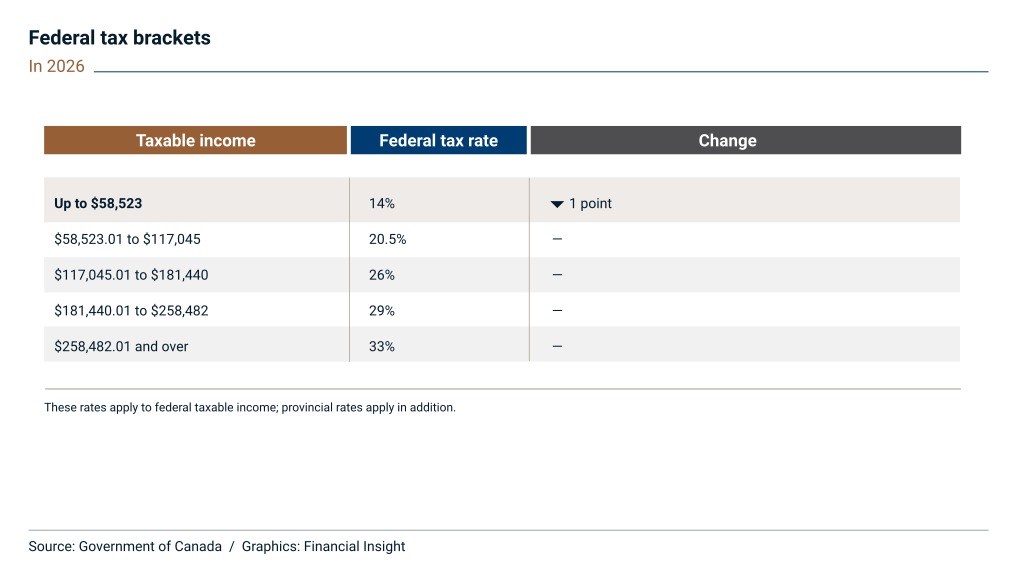
Of course, these few reminders just skim the surface. Your personal situation – age, family circumstances, business structure, income, plans for the future, etc. – must be taken into account to determine which ones might apply to your situation and how to prioritize them. The best way to turn all this information into solid decisions? A conversation with your advisor, well before your New Year’s dinner goes into the oven.
The following sources were used to prepare this article:
Canada Revenue Agency, “Calculate your TFSA contribution room”; “How to participate in the Home Buyers' Plan”; “Donations and gifts – Personal income tax”; “Capital Gains – 2025”; “Capital gains realized on gifts of certain capital property”; “ T2 Corporation – Income Tax Guide – Chapter 4: Page 4 of the T2 return”; “Line 9060 – Salaries, wages, and benefits (including employer's contributions)”; “Participating in your FHSAs”; “Capital losses”; “MP, DB, RRSP, DPSP, ALDA, TFSA limits, YMPE and the YAMPE”; “Life insurance policy”; “Receiving income from an RRSP”; “Current year tax rates and income brackets (2026)”; “Registered Retirement Income Fund.”
CFLG, “The Importance and Benefits of Year-End Tax Planning.”
Desjardins, “Expliquer les distributions de fin d’année.”
Government of Canada, “How much you could get in grants and bonds”; “Important dates for RRSPs, HBP, LLP, FHSAs and more”; “Do you qualify – Canadian Dental Care Plan”; “Old Age Security pension recovery tax”; “Registered Education Savings Plans and related benefits”; “Capital losses.”
MNP, “Conseils avisés pour planifier la fin d’année fiscale de votre entreprise.”
Retraite Québec, “Contributions to the Québec Pension Plan.”
Revenu Québec, “Increase in the Small Business Deduction Rate.”
Thomson Reuters, “Corporate Passive Income Taxation Changes.”

